Workplace Trends 2026: 8 Office Design Trends Every Organization Should Know
Updated: May 27
Interpreting Gensler “Workplace Trends for 2026” Through the Lens of Thailand

Why Workplace Trends 2026 Matter for Organizations in Thailand
By 2026, the biggest office question is no longer:“How do we force people back to the office?”
The real question is:“If people are coming in… what makes the office worth the trip?”
Worth the commute.Worth the energy.Worth the focus.Worth collaborating in person.
According to Gensler, the future workplace is about “bold moves + human-first design” — alongside the rise of AI that no longer simply answers questions, but actively becomes part of the team.
But applying these ideas in Thailand comes with unique challenges:
Limited office footprints
Rental constraints
Noise issues in open-plan offices
Heat and comfort considerations
Meeting-heavy work culture
Teams that want collaboration without constant distraction
This article by The Collective Studio highlights 8 workplace trends most relevant for Thai organizations, translated into practical office design strategies that can actually be implemented.

1) AI Is Becoming a “Teammate,” Not Just a Tool
AI-Ready Workplace
In: Working with AI
Out: Simply using AI
AI is evolving beyond search tools and chat assistants.It is becoming an active participant in meetings, documentation, workflows, and decision-making.
This changes how offices should function.
What this means for office design
Meeting rooms must support real collaboration, not just conversations
Audio quality becomes more important than oversized screens
Acoustic performance, lighting, and recording clarity matter more than ever
Offices need more spaces designed for focused thinking and deep work
Easy upgrades without major renovation
Improve meeting room acoustics with sound-absorbing materials
Reduce echo and speech interference
Create a “meeting output” culture:
meeting summary
action list
follow-up within 24 hours

2) Stop Measuring Attendance. Start Measuring Connection
Connection-First Office
In: Human Connection
Out: Occupancy Metrics
Having more people in the office does not automatically create better teamwork.
Many workplaces today still look like this:People arrive → put on headphones → work alone.
So the real question becomes:
“What is the office actually for?”
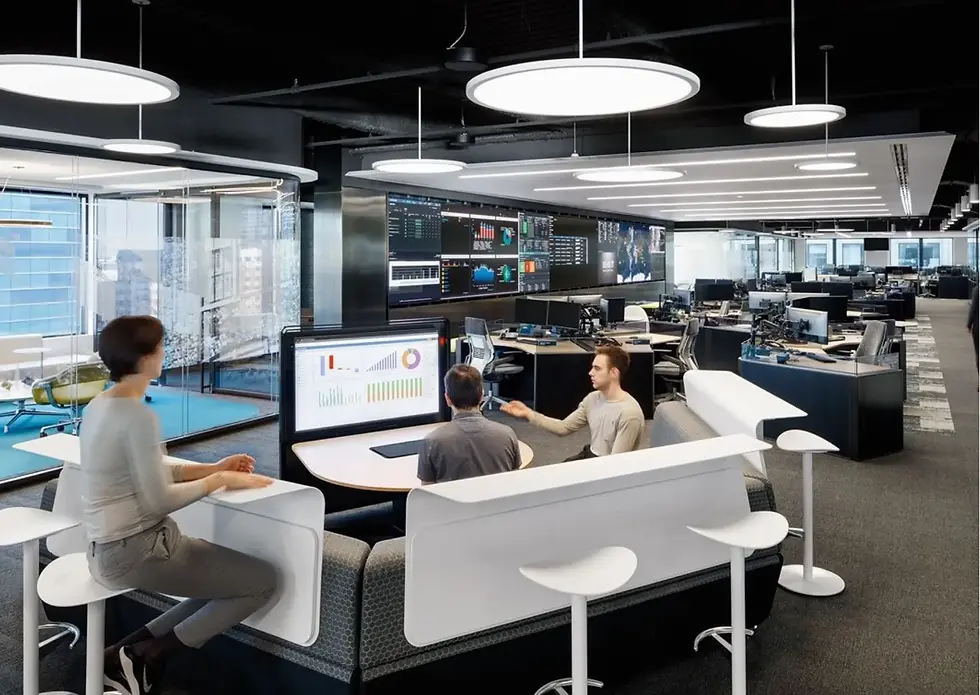
The modern workplace should make spontaneous interaction easier — naturally, not forcefully.
Design moves that work
Create one intentional “social node” instead of many tiny pantry corners
Design for serendipitous interaction:
standing tables
casual coffee zones
flexible lounge seating
informal collaboration spots
3) From More Data to Better Insights
Smarter Workplace Metrics
In: Insights
Out: Data Proliferation
Many organizations collect more workplace data than ever before — but still struggle to make decisions.
The problem is not lack of data.The problem is translating data into actionable spatial insights.
Measure fewer things — but use them properly
Conduct a small post-occupancy review 30–60 days after moving in or renovating.
Focus on real workplace issues:
Noise levels
Lighting quality
Meeting room availability
Workflow bottlenecks
Privacy
Visitor flow
Employee comfort

4) Design for Career Stages, Not Generations
Career-Stage Workplace Design
In: Career StageOut: Generational Stereotypes
Workplace needs are shaped less by age — and more by professional roles and career stages.
Different stages need different environments
Early-career employees need mentorship and learning opportunities
Mid-career professionals need fast collaboration and teamwork
Leadership teams need access to people while maintaining focus for decision-making
Design strategies
Zone spaces based on activity instead of hierarchy
Create informal coaching and review areas
Encourage visibility without sacrificing concentration

5) Seamless Phygital Experience
Technology That Feels Invisible
In: Phygital
Out: Tech Hype
Employees do not want ten apps for one task.
The best workplace technology is almost invisible — it simply makes work easier.
Two high-impact workplace systems
Easy meeting room and workspace booking
Smooth visitor experience:
registration
check-in
navigation
meeting coordination
Good technology reduces friction instead of showing off innovation.

6) More Choices — But Designed Intentionally
Purposeful Abundance
In: Purposeful Abundance
Out: Musical Chairs
The future office does not necessarily need more space.
It needs better choices.
Employees should be able to choose spaces that match their work mode.
Essential zones every office should have
Quiet focus area
Phone booths or online meeting pods
Quick collaboration spots
Informal standing discussion areas
Easy starting point
Add 1–2 phone booths
Create a quiet corner with:
soft lighting
acoustic materials
comfortable seating

7) Separate “Talking” from “Thinking”
Inconvenience Over Proximity
In: Inconvenience
Out: Proximity
Being physically close does not always improve productivity.
If collaboration zones sit directly beside quiet zones, neither works properly.
Modern workplace planning should help people shift between work modes naturally.
Spatial flow matters
Want to collaborate? → Move to collaboration zone
Need focus? → Move to quiet zone
Need online meeting? → Use designated booth
This often solves open-plan office problems more effectively than simply asking everyone to “speak more quietly.”

8) People Change Mindsets Throughout the Day
Mindset-Based Workplace
In: Mindsets
Out: Personas
People constantly switch modes throughout the day:
focused
collaborative
curious
stressed
creative
tired
The office should support these emotional and cognitive transitions.
One overlooked feature: real recovery spaces
Many offices have Instagram-worthy corners — but no spaces people can truly relax in.
Small recovery spaces can dramatically improve focus and reduce fatigue.
What works
Comfortable seating
Soft lighting
Semi-private atmosphere
Low-distraction environment
Spaces away from circulation paths
A Practical Workplace Checklist for Thai Organizations
If your company is planning to renovate or relocate, start with these questions:
Are meeting rooms acoustically clear for hybrid meetings?
Does the office have a real social node where interaction happens naturally?
Are there quiet zones and proper phone booths?
Is room booking and visitor management seamless?
Do you collect workplace feedback after move-in?
Does the office support different work modes throughout the day?
The workplace of 2026 is not about looking futuristic.
It is about working better for real human life.
AI may replace parts of workflows, but the real value of the office lies in:
human connection
collaboration
focus
comfort
emotional well-being
meaningful experiences
The future office is not simply smarter.
It is more human.
This article is summarized and interpreted from insights presented in “10 Workplace Trends for 2026: What’s In and What’s Out?” adapted and contextualized for workplace design and organizational culture in Thailand.